Reviews:
The New York Times, May 20, 1987
By Stephen Holden:
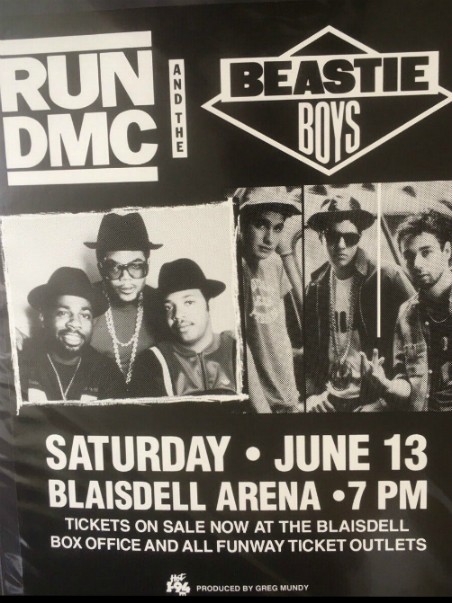
RUN-D.M.C. and the Beastie Boys, the country's two most popular rap
music acts, have announced a 40-city summerlong tour tentatively
scheduled to begin in Honolulu on June 13 and to culminate at Madison
Square Garden on Aug. 17. The "Together Forever" tour will be one of
the few in pop music history to give top billing to black and white
acts of equal stature. Both Run-D.M.C.'s latest album, "Raising
Hell," and the Beastie Boys' debut, "Licensed to Ill," have
surpassed the three million mark in sales.
Los Angeles Times, June 17, 1987:
...This was the first mainland stop on the colorful and controversial
groups' U.S. tour after a weekend show in Honolulu. There were
frequent reminders that police, promoters, parents and fans around the
country were watching the events here to see how to react when the
tour pulls into their towns.
USA Today (19 June 1987) - Edna Gundersen:
Run-D.M.C. and the Beastie Boys are putting rap on the map. The trios
that parents wish would disappear forever have boldly embarked on
Together Forever, one of summer's highest-grossing, toughest-going
tours and an expedition sure to draw fire and ire from the nation's
Jerry Falwells and Tipper Gores.
"This is a thrilling, ground-breaking show," says Bill Adler,
director of Rush Productions, which manages both groups. "You could
compare it to James Brown touring with the Rolling Stones."
The Beastie Boys LP, Licensed to Ill - the fastest-selling debut in
Columbia's history - has sold nearly 4 million copies and has held
Billboard's No. 1 spot for six weeks. Run-D.M.C.'s third LP, Raising
Hell, passed the 3 million mark - peaking at No. 3 during a 54-month
chart run.
No doubt about it: both groups are hot, but they're taking more heat
than they feel is deserved.
The tour began last Saturday in Honolulu amid a media blitz that
braced the public for trouble. Says Beastie rapper Michael "Mike D"
Diamond: "It was, 'Uh-oh, watch out! Run-D.M.C. and the Beastie Boys
are coming to town!' I guess they were expecting street gangs to kayak
their way to Hawaii and destroy the place."
The Hawaii show was trouble-free, as were stops in Portland, Ore., and
Seattle. Portland police, anticipating a repeat of a melee spawned by
a Beastie Boys show there in January, assigned 90 officers (as opposed
to the usual four) to the event and charged promoters $4,500.
Why the rap flap? Run-D.M.C.'s rowdy reputation sprang from 1986's
calamitous Long Beach concert, the only show in 65 marred by violence.
Gang fights injured 45.
Overnight, Run-D.M.C. became synonymous with street crime, thanks to
guilt by geographic association: Muggings linked to a New York show
occurred eight blocks from Madison Square Garden. And in Pittsburgh,
brawls blamed on the group's concert took place a mile from the arena.
"We don't try to whitewash the fact that there have been problems,"
Adler says. "The purpose of rap is to excite the crowd. Difference is,
Run-D.M.C. draws a predominately black crowd, and that's where racism
steps in. This country is terrified of black youths."
The tour implements extraordinary security measures: an 80-foot stage
barricade backed by a 60-foot padded version, metal detectors, extra
security forces. The groups devised and paid for the system.
"We're spending an extra $600,000, maybe more, to keep the
knuckleheads out and to keep our fans safe," says Darryl McDaniels,
a.k.a. D.M.C. "When we had the concert in Long Beach, I was so mad
that those gangs messed up our show. After all the bad publicity, we
were scared. We said, 'Oh no, our careers are over.'
"There's a negative element through the world. We can't control that.
We ain't no psychologists or sociologists."
Says Adler: "These groups have their enemies. Lots of people would be
pleased to see the tour fail, to see shows disrupted by violence."
The USA tour comes on the heels of European dates bedeviled by bad
press. In Liverpool, Beastie Boy Adam "Ad-Rock" Horovitz was arrested
for throwing a can of beer into a girl's face after rival rugby clubs
clashed at a concert. (The empty can "richocheted" off Horovitz,
Adler said.) In Paris, audience members yelled racial slurs at
Run-D.M.C. and spat on Joseph Simmons, a.k.a. Run. And in London,
Fleet Street tabloids concocted a story that the Beasties had insulted
disabled children.
"Complete fiction!" says Diamond. "We gave autographs to a kid with
leukemia. We're not out there to hurt anybody."
Complains Simmons: "The press was frustrating. They made big hype
about the Beastie Boys. They lied."
Rumors of racial friction and jealousies between the groups crop up
frequently, despite their colorblind attitudes. Both have conquered
black/ white boundaries in music. Run-D.M.C., the first rap act to
earn gold and platinum albums, crossed over to white audiences with
their version of Aerosmith's Walk This Way.
Before capturing white suburbia with the smash (You Gotta) Fight for
Your Right (To Party), the Beasties built credibility by winning black
fans. "Otherwise," Adler says, "they would have been a white-bread
oddity."
Still, some resent the white Beasties' domination of rap, a black
invention that sprouted from the Bronx-born hiphop subculture of
street jargon, breakdancing and graffiti. At a black music convention
in New York, some rappers complained the Beasties were grabbing glory
they didn't earn.
"They think it's like Elvis getting credit for rock 'n' roll,"
Horovitz says. "Jam Master Jay (Run-D.M.C.'s DJ) stood up on a table
and told them, 'Who do you people think you are? You're the racists.
We should do this together.' I'm glad Jay stood up for us. It makes me
mad that people don't see that we're trying to promote black rap
groups. We're opening for Run-D.M.C."
Those who accuse the Beastie Boys of infringing on black turf are
jealous, McDaniels says, emphasizing that the Together Forever tour
embraces racial harmony: "It's not black or white. It's music."
Says Diamond: "Reporters keep asking, 'Don't you feel silly being
white and Jewish?' It never occurred to us that because we're white we
shouldn't do rap. Run-D.M.C. broke ground for us. We're breaking
ground for the next rappers. We want to bring all these kids together
in one place."
Adler, whose Tougher Than Leather (NAL, $2.95) biography of Run-D.M.C.
will be out in July, says fans will recognize the show's positive
message.
"The Beastie Boys are saying it's all right to have fun, even in the
current conservative social and political climate. They like sex and
they don't pretend not to.
"And Run-D.M.C. are heroes. They're Muhammad Ali times three. Unlike
Prince or Michael Jackson, they're manly and accessible role models.
They're not cross-dressers. They're like real kids."
Real kids with big dreams.
"We want to be like the Beatles," says McDaniels. "We want to be
remembered. We're not doing this for the money. All I need is enough
to buy a bag of potato chips, keep gas in my car and get new sneakers.
I'm happy that I can pay my own dental bills and buy nice things for
my mother."
Hardly the words of a renegade hooligan.